

Something feels off in the way we’re using AI.
Not because it doesn’t work. It does work, which is part of why the deeper issue is easy to miss. You ask a question, it gives you an answer, you refine it, and you move faster. In many cases, that’s very useful.
But moving faster is not the same as thinking better, and it’s certainly not the same as changing the underlying pattern.
I’ve spent a lot of time in systems where ideas are not the constraint. Often, the insight is already there. The solution is partly visible. The problem is that the thinking is scattered across conversations, documents, intuitions, tensions, and half-finished attempts to explain what someone already knows.
The bottleneck isn’t intelligence, it’s holding capacity. People are trying to carry too much complexity in their own heads. This is where AI becomes interesting to me.
Not as the proverbial better search engine or a content machine, and most certainly not as a shortcut around human judgment.
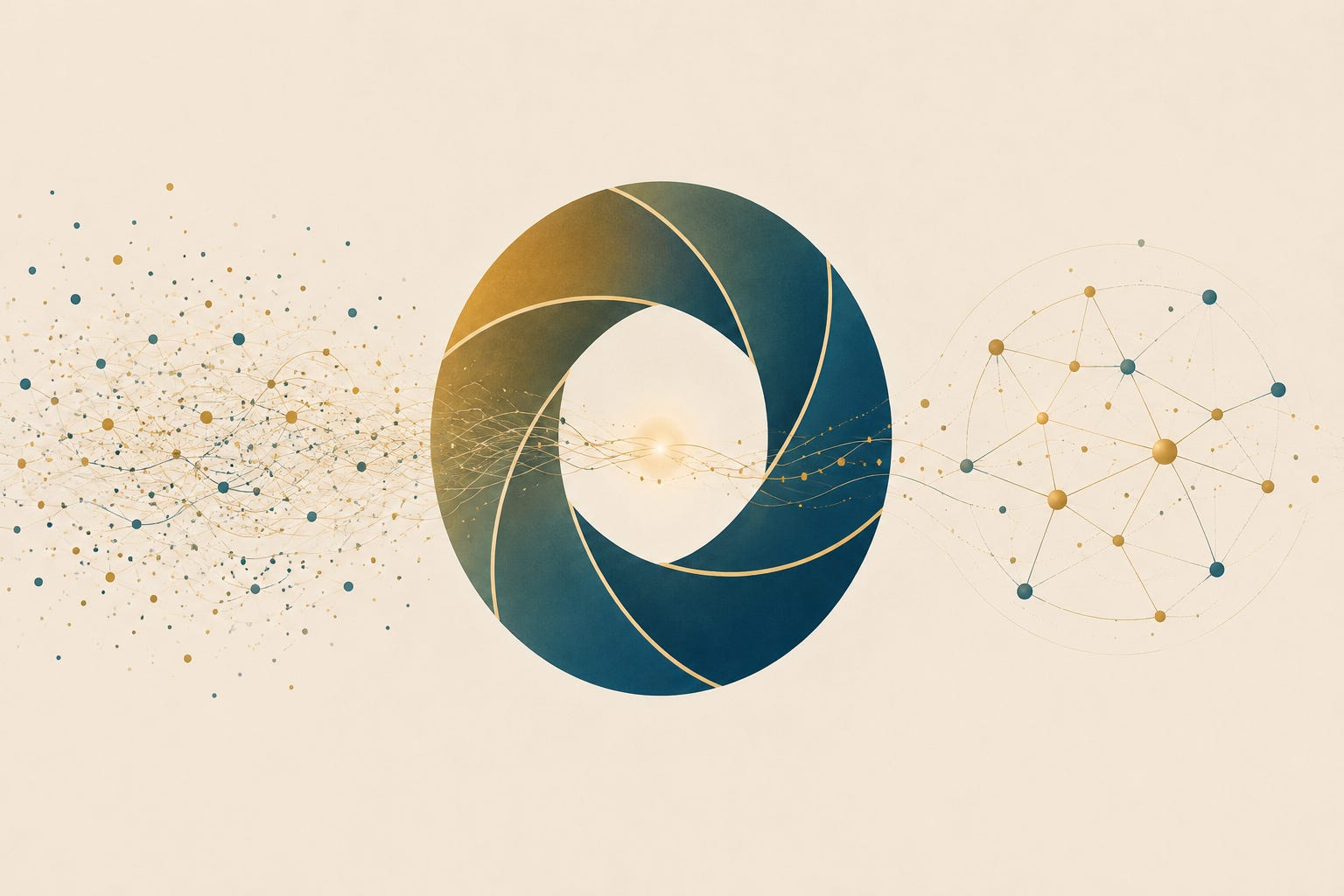
But as a way to get thinking out where we can see it.
When AI is used transactionally, it mostly amplifies what’s already there. It gives cleaner answers, faster drafts, better summaries, and more efficient output. That has value, but it can also leave the deeper pattern untouched. You are left with the same assumptions you came in with, including the same blind spots, and the same way of framing the problem. It’s just faster.
But when you stay with something unresolved a little longer, a different possibility opens: AI can begin to reflect the shape of your thinking back to you. Certainly not perfectly, magically, or an authority. But in fact, very usefully.
It can show you what you keep circling. Where you’re narrowing too early. What assumptions are sitting underneath the question. What structure might already be present in the mess. What you know, but haven’t yet found a way to say…
That’s a much more uncomfortable way to use AI, because it asks more of the human, not less. You have to bring real material. You have to notice your own resistance. You have to stay in the conversation long enough for something more than an answer to emerge. But that’s also where it becomes useful in a deeper way.
The risk is not only that AI becomes too powerful. The quieter risk is that we use it to become more efficient versions of exactly who we already are.
More productive, but not more discerning.
More articulate, but not more honest.
Faster, but not wiser.
I’m interested in a different use, where we develop AI as a thinking partner.
A way to work with complexity without collapsing it too quickly.
A way to externalize what’s hard to hold alone.
A way to see patterns, test assumptions, clarify decisions, and turn insight into usable form.
Not to replace thinking, but to make more of it visible.
That’s what I’ll be exploring here.
This reminds me of a post I recently wrote, we’re coming to a collective understanding! For me, having my internal thoughts explored without judgement has been a major benefit of AI. I can ask “why do I se a connection between these two things?” And it won’t say “huh?” It continues to pull the thread of my thinking so I can articulate it to those around me.