Prefer to listen instead?
The spoken version of this essay is available above. You can also subscribe to The Aperture Field Notes wherever you listen to podcasts.
I’ve noticed in recent years that leadership and development conversations often treat joy as an outcome we should be tracking, as if it tells us whether we are aligned, awake, or on the right path.
There is a subtle pressure in that framing. Joy or bliss begins to sound like a state we are supposed to maintain, and if we are not feeling it, perhaps we are behind the curve. And to be fair, there is something understandable and compassionate about this trend. People are exhausted inside brittle systems that are breaking around them, and joy sounds a lot like relief right now.
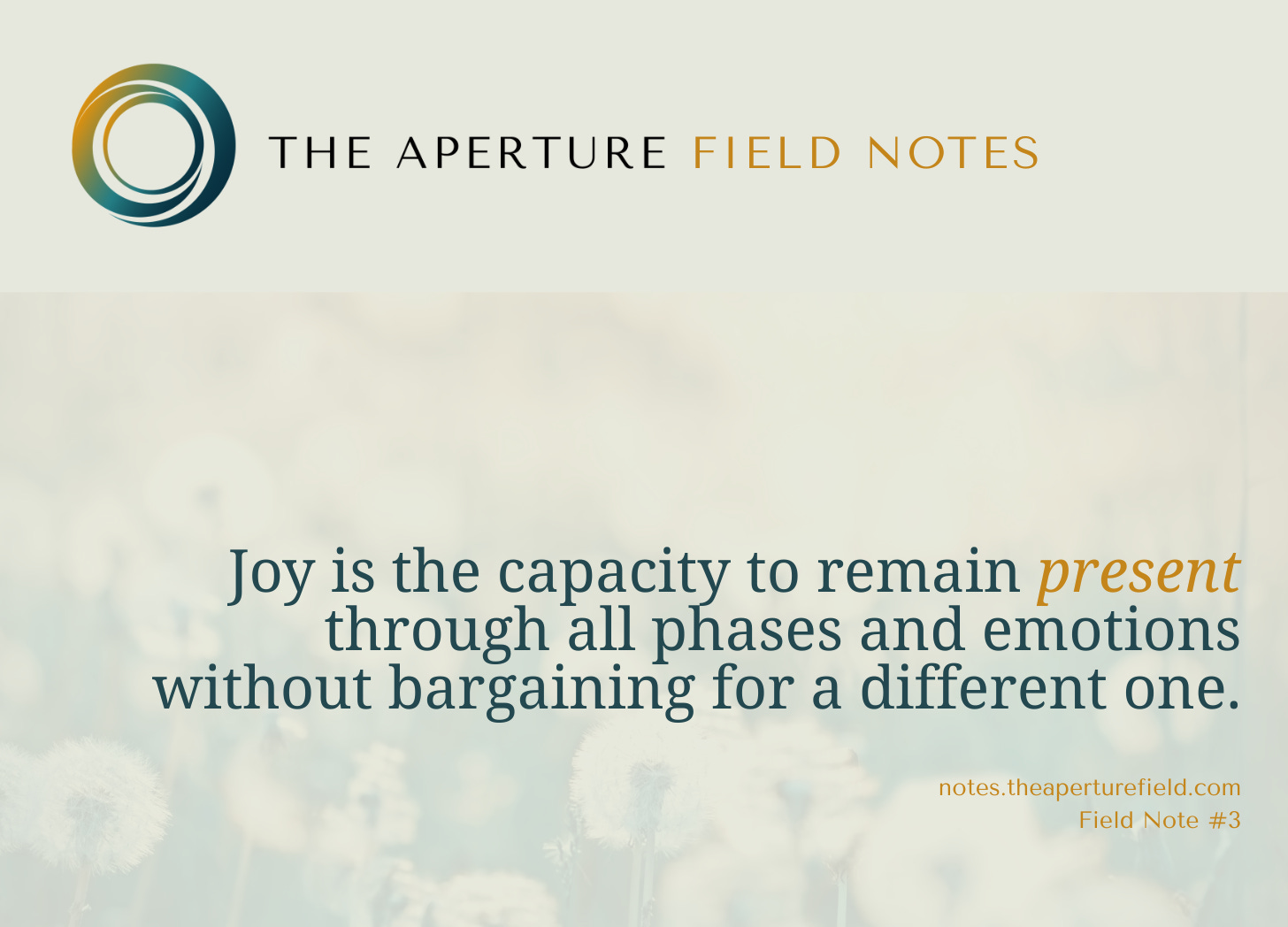
But I find myself struggling with the singular focus on joy. Not because joy is wrong, but because it is not the whole picture.
When joy becomes the goal of success, purpose, or awakening, the experience of life itself starts to narrow. Moments become assessed by how much joy they contain, instead of being met for what they are. Feeling becomes ranked on a scale, with joy at the top and everything else falling somewhere below it.
When joy is the metric, life becomes something to optimize instead of something to inhabit.
And joy is only experienceable because it exists in contrast with other states. If we focus exclusively on joy, we lose the texture that allows joy to be known at all. We also lose sight of the beauty in quieter states: equilibrium, coziness, calm, bittersweetness, undramatic stillness, and the subtle beauty that doesn’t announce itself as joy.
All the pastels of the emotional colour spectrum.
Framing life around perpetual joy risks becoming lopsided, not because joy is unworthy, but because no single emotional state can hold the whole of lived reality.
A wider lens: non-attachment, not emotional suppression
I’ve noticed a familiar distortion that appears when Eastern philosophies are translated into modern leadership language. Transcendence can start to sound like the flattening of “negative” emotions in favour of a constant state of bliss.
But as I understand it, that is neither the tradition nor the experience.
A non-attached orientation doesn’t minimize feeling. It minimizes resistance.
Joy still arises fully. So do grief, tenderness, awe, disappointment, and care. The difference is not the absence of emotion, but the non-holding of it.
Emotions, whether pleasant or painful, are still experienced in real time. They simply are not extended indefinitely by narrative, identity, or expectation. They complete themselves more cleanly. From the outside, this can look neutral. From the inside, it feels unobstructed.
Re-reading the Zen Farmer
One of my favourite parables is the story of the Zen Farmer. It is often told in a way that sounds like emotional detachment.
A farmer’s horse runs away. When neighbours come to console him for his bad luck, he responds, “Good luck, bad luck - who knows?”
Then the horse returns with several mares. The neighbours congratulate him on his fortune, and he responds again, “Good luck, bad luck - who knows?”
His son begins training the new mares, has an accident, and breaks his leg. The neighbours express sorrow at the family’s misfortune, and again the farmer says, “Good luck, bad luck - who knows?”
The story ends with the military arriving to conscript young men for war. The son’s broken leg keeps him from being taken…
This story is often read through the lens of indifference. You could almost add “who cares?” after every “who knows?”
But that interpretation misses the human middle.
When the horse returns, the farmer can notice the beauty, vitality, and new life entering the field.
When the son is injured, the farmer can meet him with care, empathy, and presence.
What he does not do is cling to the pleasure or prolong the pain.
Feeling is not absent. Attachment is.
This form of appreciation doesn’t try to preserve the moment indefinitely. Joy can be appreciated without being hoarded. Sorrow can be honoured without being rehearsed. Meaning can arise without being extracted.
The goal is not to detach from life. It is to experience intimacy with the moment without caging it.
And in leadership, this matters deeply. Many leaders today are navigating complex situations without clear resolution. They are carrying responsibility without full control over the means. They are working inside systems that cannot be fixed by positivity. In these contexts, joy-as-metric can feel hollow because the frame is too simple.
What is needed is not brighter emotion, but greater coherence. When leaders are taught to seek joy, they may inadvertently learn to avoid discomfort. But when leaders learn to meet experience as it is, they develop steadiness, clarity, and trust in movement.
Coherence doesn’t demand joy. It allows joy, grief, neutrality, uncertainty, and care to move through the system without distortion.
This is not an argument against joy. Joy is welcome.
But so is everything else.
The work is not to feel better. It is to see clearly, meet what is here, and allow life to move through us without unnecessary friction.
In that clarity, joy often appears quietly, briefly, and exquisitely.
And then it goes.
As it should.