

It seems to me that one of the most common topics of conversation right now is on the extreme polarization present in the world today and on trying to find a path to alignment while experiencing what seems to be completely different ways of seeing in the world. Each side sees the perspective of the ‘Other’ as the problem, and seeks to correct them of their mistaken notions.
The Great Sorting of the Ways of Being..
I have been spending time reading the books of Adam Smith, starting with his Theory of Moral Sentiments - what a ride that has been and completely surprising to me in what it actually says about polarization and conflict.
As I see it, modern political systems, whether it be at the municipal, provincial/state, or federal level, reward the differentiation of political parties and candidates, using the most emotional issues to gain people’s empathy towards a common cause. Once you have empathy, you can lead people to what the ‘solutions’ are that you can provide. We know these as political ‘ideologies’ and put neat labels on them to help us define who someone is by the ideologies they hold, words like conservative or liberal, autocracy or democracy, or the biggies: capitalism, socialism and communism.
I took a look on Wikipedia to see what it said about political ideologies, and it says:
“a political ideology is a certain set of ethical ideals, principles, doctrines, myths or symbols of a social movement, institution, class or large group that explains how society should work and offers some political and cultural blueprint for a certain social order.”
It goes on to say that political ideologies concern themselves with two major dimensions: 1) how society should be organized (goals) and 2) the most appropriate way to achieve this (methods). But the main point is that it is a collection of ideas.
And that gets me thinking - working in innovation taught me one somewhat commonly known thing: ideas, as powerful as they can be, are a dime a dozen. There are seemingly infinite ideas that are brilliant ways to solve problems, but the idea itself is only the tip of the iceberg, because once you add in the greater context of the system you are trying to change, things get awfully sticky, awfully quickly.
Sand on the Beach
So let’s say ideas are like sand on the beach. Countless grains of sand that we can pick up a handful of and call ‘sand’ as though it is a singular thing. I have in my hand, brown ‘sand’. But have you ever tried to actually look at what composes sand? It’s a stunning thing… take a pinch and blow it up under a microscope and you get a stunning landscape of colours, shapes and things..

As a child, I used to try to ‘sort’ these tiny grains of sand into piles of colours.. a task that kept my mind occupied while I laid in the hot sun with my swimsuit steaming from a recent swim.. I had fanciful ideas of an artistic beachscape where the sand had been sorted into types, and you could walk in the purple sand, or the clear sand, or the black sand… spoiler alert - the activity never achieved the envisioned outcome, LOL.

But what if political theories are kind of like that? We try to take collections of what seem like similar ideas, and create ideologies around them, shutting out the value that might be represented in the other fragments along the way. Capitalism goes into the stack of gold agate fragments over to the right, and Socialism goes into the green fragments on the left, etc. And pretty soon, you get these neat, beautiful ideologically stunning stacks of the same thinking, and it all hangs together, because it is indeed very similar in texture and colour.
And yet, that’s not how society is built - it isn’t just one type of person, it’s a multitude with different stages in life, different ways of walking, thinking and being, and different needs. It strikes me that there is value in more than one colour of sand in the mix of what makes up our societal ideologies..
Because an ideology isn't merely a set of ideas; it is an act of sorting. And the danger isn't that the pile contains false grains. The pile may largely consist of perfectly valid grains, but the distortion comes from believing that because the grains belong together, they constitute the whole beach.
The Outrage of Difference
Back to Adam Smith.. because he makes a strong point about how we become polarized in the first place. As we identify with our ideologies, we begin expecting the ‘other side’ to adopt our outrage and validate our perspective because obviously it’s the ‘right’ one and we have been studying it hard for decades - all the grains of sand in this pile are purple, so the answer is clearly some form of purple. Once I identify strongly enough with my purple pile, I can't understand why you don't experience its truth with the same intensity I do. And when they fail to agree, we label them as cold, insensible, or unreasonable (or worse), because if you’re not with me, you are, of course, against me.
In Chapter 4, Smith makes the profound observation that when an issue deeply affects us, preserving moral harmony becomes vastly more difficult (and vastly more important) than in the more detached ‘academic debate’. Smith’s perspective was that reaching this harmony isn’t about passive compromise or waiting for the other side to change, but instead requires a simultaneous, dual effort of mutual accommodation.
The Spectator’s Duty - Active Imagination
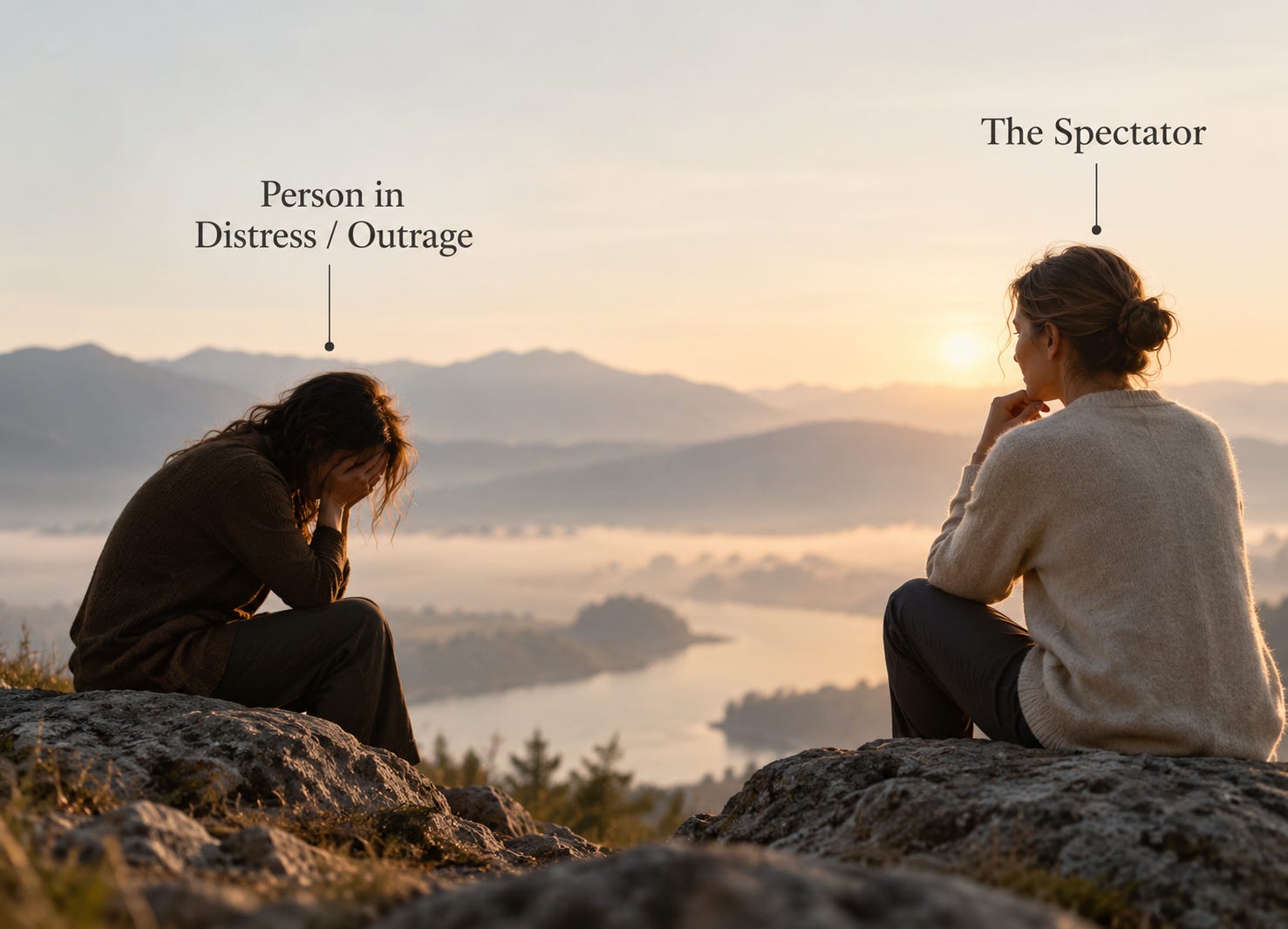
Smith talks about the two roles in disagreement as the “Person Principally Concerned” which I will refer to as the “Partisan” (the person in distress/outrage) and the Spectator (an outsider to the situation).
The Role of the Spectator..
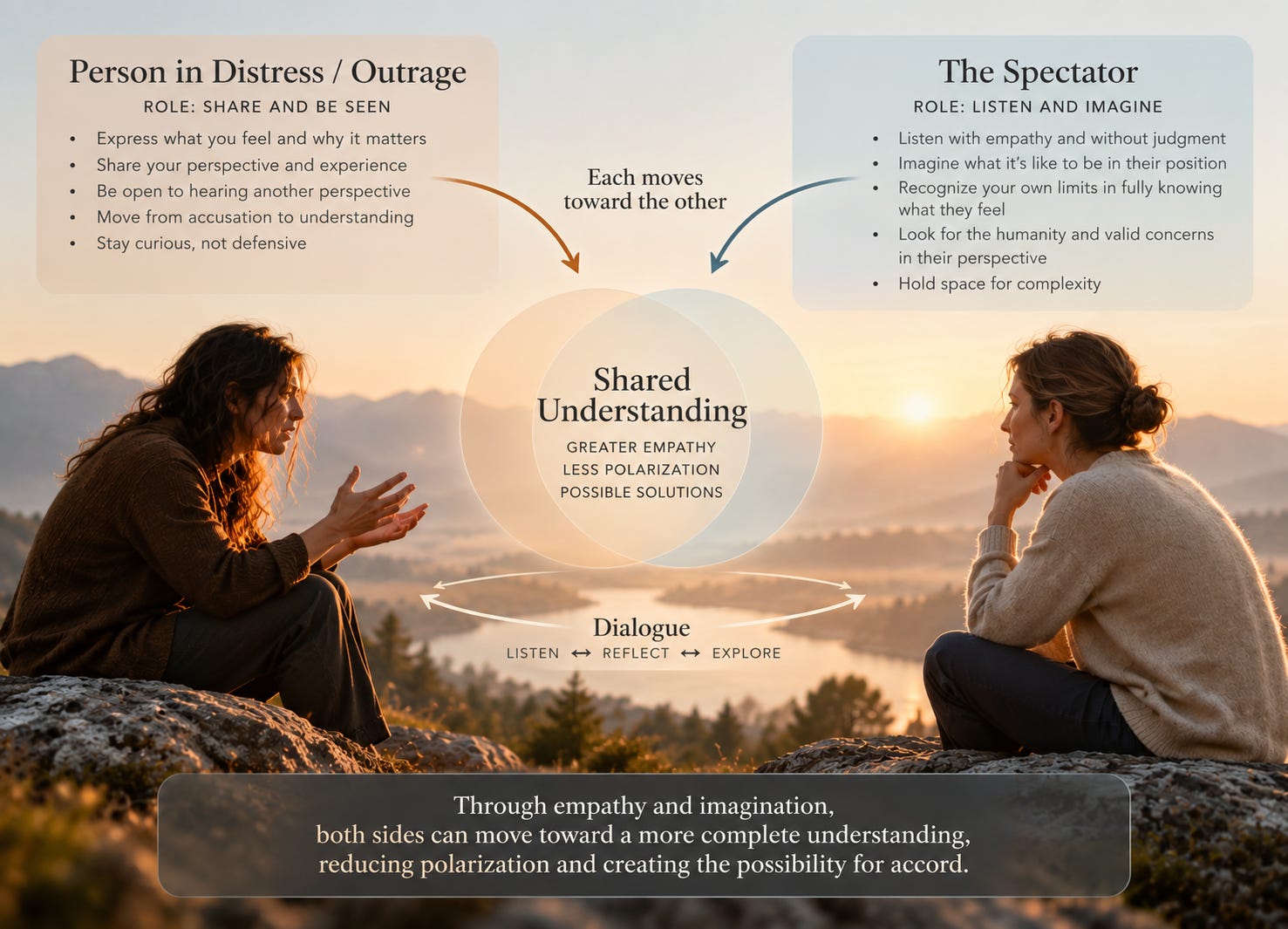
For a spectator to sympathize with someone in distress or outrage, they cannot remain passive. Smith argues that the spectator has to make an active effort to put themselves into the situation of the other person, adopting “every little circumstance of distress.”
As citizens and neighbours engaging across political lines, our first duty is an imaginative one where we actively investigate what life experiences, fears, or grievances drive the convictions of those with whom we disagree. But Smith also acknowledges that a spectator’s sympathy can never fully reach the original intensity of the person who is directly involved, because first, you can’t actually completely imagine what it is like to be the other person without being that person, and second, “the thought of their own safety, the thought that they themselves are not really the sufferers.” continually intrudes into ‘living the other person’s’ experience. And that’s why the spectator’s effort alone is never enough.
The Role of the Partisan…
Because the spectator’s sympathy has natural limits, the person who is experiencing the intense passion also carries a heavy moral responsibility. In order to gain the sympathy and connection of the others, the passionate partisan must “flatten… the sharpness of its natural tone” to a pitch that an impartial bystander can actually go along with.
And I think this is super hard for us on many levels right now - there are so many ways that we in society have wronged and hurt one another - how we have taken personhood away from cultures, genders, and ways of being, how we have taken belongings and land from other societies, how centuries and millennia of continual war have caused deep anger and hurt between countries and even families.
How can Smith be so glib in suggesting we should temper our anger when we are one of the ones experiencing the role of victim?
Moderating expression is not minimizing injustice.
Smith isn’t necessarily saying the grievance should become smaller or that the injured person should pretend the injury was less severe than it actually was. He’s making a claim about what is required for another human being to accompany you emotionally. That’s quite different, and politically uncomfortable in an interesting way.
Because he is saying that when we express political arguments, we can’t expect others to embrace extreme anger or maximalist rhetoric and that we have a duty to exercise self-command, moderating our emotional intensity so that conversation remains possible, and the Spectator can actually remain present and seek to understand.
Concord, Not Unison
Going back to that beautiful handful of sand.. in the end, the goal is not to actually make all the sand brown, as it appears at first glance. Human sentiments do not actually need to be in unison where everyone has identical feelings or total agreement in order to achieve social stability. Smith says there only need to be ‘concords’ (harmonious differences).
In other words, societal harmony doesn’t require everyone to think or feel identically. The Spectator must move toward the Partisan through imagination, while the Partisan moderates the expression enough to become reachable - each side moves toward the range in which the other can hear them. Active social intercourse and open conversation are the most effective remedies for restoring peace and preventing factions from brooding (and escalating) in isolation.
Conclusion: Concord despite difference
Getting back to a society that works in harmony is not a weak surrender of principles. The Partisan and Spectator don’t meet because each moves to a predefined political centre. They undertake different reciprocal movements that make mutual intelligibility possible. The destination is not necessarily “moderate opinion.” It is concord despite difference.
Working towards concord is a high-level moral discipline that requires both empathy from the Spectator and restraint from the Partisan.
I see this as two kinds of ‘unsorting’ we are learning as a society right now:
Cognitive unsorting: where we stop treating one ideological collection as the complete description of reality.
Relational unsorting: where we stop treating the person holding another collection as incomprehensible, immoral, or outside the civic “we.”
So here is the challenge I’ve set for myself, and I invite you to meet me in it.. to listen with a more active imagination to a viewpoint you oppose, and moderate the sharp edge of your own political expressions so as to create space for our Spectators to understand.
Watch the explainer video on YouTube:
AI Use Disclosure: This explainer video and images were created with the support of AI tools. I used Claude to help translate my original written piece into a visual explainer, using a recording of my own voice as the narration source. The ideas, writing, perspective, and final editorial choices are my own.