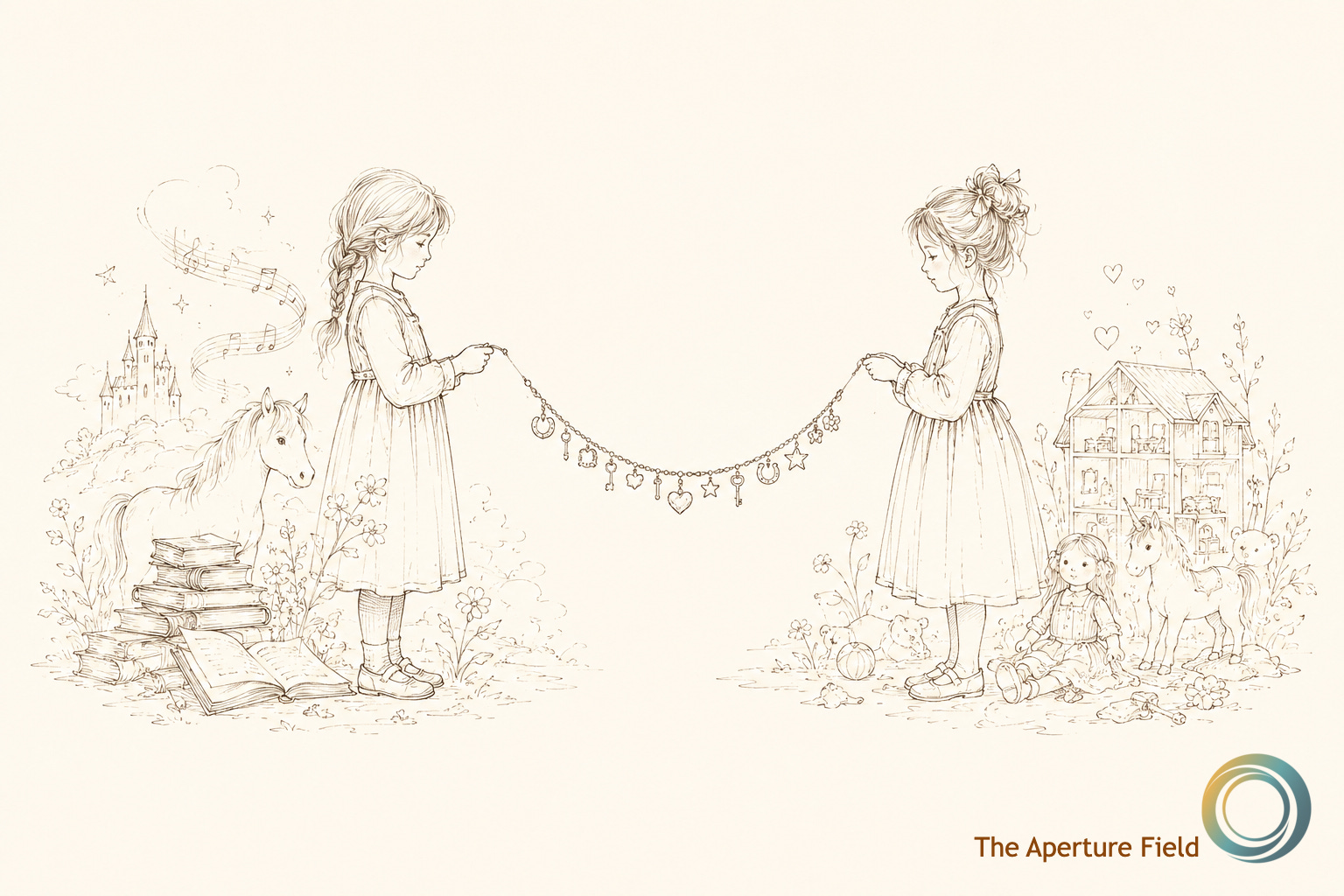
I was lost in thought this morning about a time when I was in early elementary school and my little sister’s birthday came to pass. Now, in those days (at least in my family), we didn’t get spending money for presents for our siblings, nor did we live near stores, and so birthday presents usually came from adult family members.
But then one year, my sister’s birthday came, and suddenly I wanted to be part of it and give her something from me. Only I realized that fact as family members were already arriving for her birthday party. And so, I quickly looked around my room, and thought of everything I had that looked like something she would also like. But my sister and I were very different people. I was consumed by fantasy books, music, and horses. She was very experiential, with dolls that talked, a large Barbie and My Little Pony collection, and other interactive toys. As I looked around my room, nothing was right.
I began madly opening drawers and stumbled across my nightstand drawer, which was filled with cheap charm necklaces and a bunch of fake money.. she collected charm bracelet stuff and loved money and gosh, I didn’t even ever wear these anyway, so I wouldn’t even miss them… we had a WINNER!
I quickly took the entire contents of my drawer dumped it unceremoniously into a wrapping paper nest, and with my heart brimming with excitement and the joy of sharing, I quietly added my gift to the pile. Upon seeing my gift, my sister looked at me in surprise and excitement (I was delighted! I couldn’t wait for her to love my gift), and she ripped open the hastily wrapped and tape covered mess of paper.
And as she opened it, her expression went from excited to confused, and the tenor of the room changed dramatically.. “you gave me your worn out charm necklace?” In that instant, I remembered she probably already had the same charms I had, and not only that, maybe the necklace itself had seen better days. Her expression changed to wondering if it was a cruel older sister joke, and my mom delivered the 1-2 punch.. “what did you do Kari, empty your bedside table drawer and just give it to your sister?”
I can’t remember if I tried to downplay it.. I kind of remember it as sort of trying to share why I thought it would be good, but quickly putting together how not-good it actually was, and feeling absolutely devastated by my own lack of preparation for her birthday and thoughtless gift.
We laugh about this now as a family - it was perhaps slightly typical of my somewhat clueless nature growing up. But it got me thinking.. the reality was that I had independently realized on my own accord, that I wanted to celebrate my sister’s birthday with her by doing something nice. I had zero practice at it, and was clueless as to what the creature who lived in the room next door to me actually liked, as all I really knew was that she made no sense to me whatsoever (sisterly love didn’t really arise for us until I left the house for college and the remaining family members experienced peace for perhaps the first time).
And over the years, I very slowly learned how to celebrate first my relationships with each family member by carefully thinking about them at their birthdays and Christmases, and hopefully giving them something special that either came from my heart and time, or was something meaningful they might enjoy. And those were baby steps towards learning a greater empathy towards others, and through many other painful missteps, I learned how to empathize in a way that brought them joy instead of confusion.
As a teenager, I wasn’t kind to my little sister, as the natural competition of siblings ensued, and an adult friend of the family took me to task for it. It was a steep learning curve for me, and the adult friend was ruthless in showing me how selfish I was in my behaviour and how hurtful I was to my sister. I’d love to be able to say that I knew that I was and this was just correction that I needed, but I really didn’t understand the perspective of someone else’s needs at that stage of my own journey.
Over time, I became fascinated with inhabiting the interior worlds of my partner, my friends, family members and others.. by building my own little model of their worlds, I could understand and predict their behaviours and as a result life got much easier. I could pick the right gifts, say the right things, feel their own pain or joy and relate to it. And the other side of the pendulum swing began.. I became so good at understanding other people that I started forgetting how to understand myself.
And this is where Carl Jung entered the story for me. Because eventually I became interested in understanding not just other people, but also why certain people affected me so strongly.
Why did one person’s behaviour roll off my back while another person’s behaviour could occupy my thoughts for days?
Why was I compassionate toward some people and reactive toward others?
Jung’s answer, at least as I first encountered it, was projection. The idea that what evokes a disproportionately charged reaction in us often points towards a similar unconscious trait within us that we carry.
At first, this felt like another expansion in empathy. Instead of asking only “What is happening for them?” I began asking, “What is happening in me?” And that question turned out to be incredibly useful.
Sometimes my reaction indeed pointed toward a trait I hadn’t recognized in myself.. something I had disowned. But over time, I started to notice something else: projection explained part of the picture, but not all of it.
I wonder if Jung’s perspective was a little lost in translation from the original German text, and if his perspective was actually more like ‘What evokes a disproportionately charged reaction in us often points toward something unconscious in us.’
The unconscious part in us may be anything from our own trait reflected back, a value we hold that is being broken, an unmet need, a disowned capacity, the opposite trait.. and on and on. But I think that’s one of two levels that ‘shadow work’ is actually about. I think we need to answer both questions in order to truly integrate the feeling so it no longer ‘triggers’ us:
why am I reacting (shadow work)
what is actually happening for the other person
So yes, we clean up our own house first (i.e. remove the plank from our own eye before addressing the speck in the other’s). But then, if we have found our own stability, the ‘stretch goal’ perhaps becomes about the fact that two systems have now collided in relationship, i.e.:
My reaction contains information about me.
Their behavior contains information about them.
The interaction between us contains information about the relationship.
And all three can be true at once.
So an example would be let’s say someone is controlling.
Level One would be the simplistic projection: “you dislike controlling-people because you yourself are controlling”.
Level Two would be “This person learned control because unpredictability was dangerous for them.”
And the second question changes something important. We still might not want them in our lives and/or refuse the behaviour and set a boundary, but the emotional field itself shifts from condemnation to understanding. It’s the difference between ‘you’re bad’ and ‘I understand how you got there’.
I think our own trauma is the work of Question 1 in unpacking the pain and suffering of our own life to see why we experience pain in colliding with this other person’s way of being. Trauma compresses pain into the perception of threat / enemy / avoid / danger.
But healing that trauma restores dimensionality, and we begin to be able to see their wound, the adaptation, the fear, the longing, and the humanity of the other person. And once we can see more clearly, our options expand. Sometimes that means repairing a relationship, sometimes it means extending compassion, sometimes it means realizing our assumptions were wrong, and sometimes it means setting a boundary. The point isn’t that every relationship should be preserved; it’s that we can finally respond to reality instead of reacting to our wounds.
And the tricky balance is that there is a trap here too - if you then only see the humanity in everyone but yourself, then you can become endlessly compassionate toward others while continually tolerating behaviors that don’t belong in your own life.
I think the true opportunity for integration is in holding both: the compassion and honouring of your own shadow and trauma while also holding compassion and honour for the trauma of the other. Boundary with compassion.
Looking back, I don’t think the lesson of the necklace was that I was selfish. I think the lesson was that I didn’t yet know my sister was a world unto herself. Growing up taught me to see other people’s worlds. Jung taught me to see my own. And relationship, I think, asks something harder still: the capacity to hold both at once.
My reaction contains information about me. Their behaviour contains information about them. And the space between us contains information about the relationship. Once we can see both ourselves and the other person clearly, we are finally free to choose our response.
“I understand why you are behaving this way. I don’t hate you for it. And I am also not available for it.”
We begin by assuming everyone is like us.
Then we discover other people.
Then we discover ourselves.
Then we learn to hold both.