

Subscribe to The Aperture Field on any major podcast platform for more..
We often talk about sustainability as though the world should exist in perfect equilibrium at all times; but living systems don’t work that way. They move through cycles of growth, consolidation, release, and renewal.
We need to look no farther than the seasons themselves: spring plants its seeds, summer is a season of growth and expansion, fall brings the harvest and evaluation as well as the pruning and cutting back of what no longer serves , and winter becomes a time of integration and preparation for what comes next.. and around and around we go.
Throughout history, we have seen this same cyclical rhythm appear again and again. We push forward and discover things that fundamentally reshape society - metallurgy, steam power, computing, AI.. In each transition, we surge toward new frontiers, summiting the edge of what we know and suddenly beholding an entirely new landscape of possibility.
But discovery is only the beginning.
What follows is always a period of incorporation, a long phase of weaving those discoveries into the fabric of society itself, fundamentally reshaping how we live, work, govern, relate and understand the world around us.
This is the natural rhythm of evolution. We push outward and find new edges. In doing so, we sense the exhilaration and fragility of standing at the boundary of the unknown and how new discoveries can either fracture systems or usher in entirely new eras of flourishing. Over time, those discoveries become integrated into the structures of everyday life. Institutions mature, systems stabilize, and society reorganizes itself around the new reality.
And eventually that very stability itself begins to harden, and what was once adaptive and life-giving slowly becomes rigid. Mature systems become stale instead of simply stable, and eventually the growth cycle begins again, nudging society forward into another period of transformation.
But the end of each of these cycles rarely feels graceful from the inside. The end of the era of growth feels more like teetering on collapse: too much unintegrated change accumulating too quickly, systems straining under the weight of their own complexity, institutions falling increasingly out of sync with what it now possible, and perhaps even necessary, for society to become.
We begin to sense that the underlying infrastructure of how we live must change, while simultaneously discovering that the very structures built to create stability are naturally resistant to fundamental transformation.
And so the cultural rhythm begins to shift and the drumbeat of relentless growth gives way to another rhythm entirely:
Integrate. Consolidate. Digest. Reorganize.
Growth gives way to application and expansion gives way to restructuring and renewal. Like a farmer harvesting fruit at its peak and storing it for the winter, we begin preserving and integrating what has been learned so that it does not simply die on the vine in an endless pursuit of more.
And perhaps this is where we now find ourselves: not at the end of progress, but at the end of a particular phase of progress. A civilization-wide pause to metabolize what we have created.
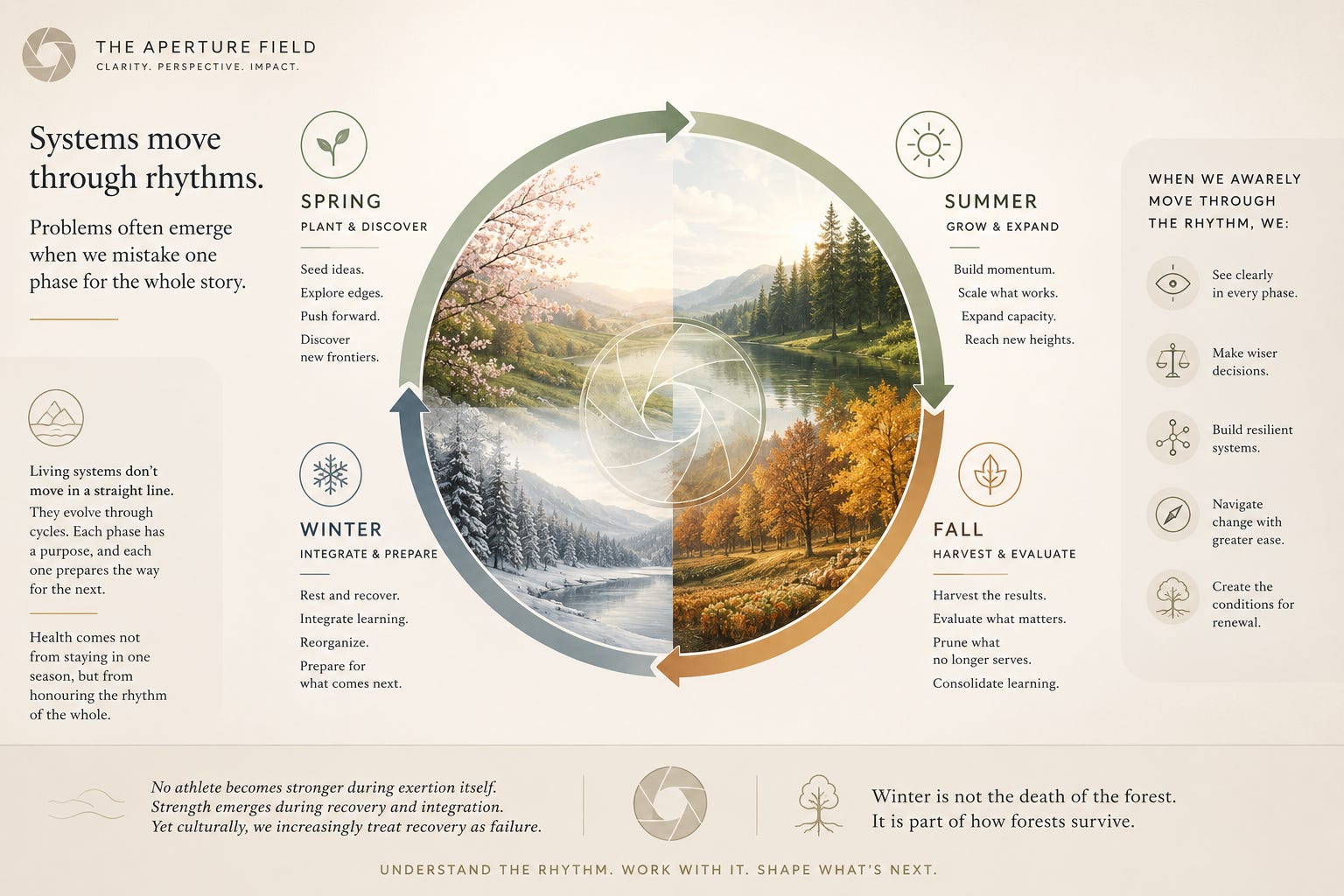
No athlete becomes stronger during exertion itself. Strength emerges during recovery and integration. Yet culturally, we increasingly treat recovery as failure.
There is no need to vilify the extraordinary growth era that brought us here, simply because it has reached its natural limits. Better that we honour what has been built, recognize the immense beauty and possibility that it created, and allow ourselves to enter the next phase consciously: one of integration, restructuring, maturation, and renewal.
Winter is not the death of the forest. It is part of how forests survive.
Love how you have positioned Integrate and Digest separately. Great reflections.
Love your take on how winter and silence are the necessary steps for sustainability, Kari! Regeneration is about the balance of action and processing, and I think you summarized it perfectly in your last quote about forests and their survival.
Thank you for sharing your thoughts on this!