

“You’ve gotta master the no-look pass,” Frank, our Texan advisor would say back in the days of our startup. He had observed our growing team and seen the problem so many startups experience when passing projects to one another - we would ‘delegate,’ the ball would drop, the deadline would slip, and we were left wondering what went wrong.
Because in the startup world, particularly in the early days, nearly everything passes through the founder, as one would expect. They act as the main integrator - the one who holds the master playbook with all the potential plays decided by them. But when startups mature and that founder remains the only person who can reliably receive and move the ball, delegation never becomes real. The “no-look pass” is the moment when leadership starts to look more like a team-based system than a command and receive operation.
Frank’s perspective was that the first thing a company needs to work on as it moves from startup firefighting to maturing company is on practicing how to pass the ball - knowing where someone will be, what they own, what they can decide, and what they need from you as the leader, without checking every time.
Most team sports with balls have the equivalent of a ‘no-look’ or blind pass. Whomever has the ball to pass doesn’t stop to verify the receiver’s position, establish eye contact, explain what’s coming, and then hand over the ball. No, they pass into space because both players have practiced the play so many times that they know exactly where one another are going to be.
Most organizations call delegation the act of passing the ball. But the harder question is whether anyone knows where to be when it arrives.
Why early stage companies struggle with passing
Early stage companies often operate a little like a hub and spoke system. The hub consists of the founder or cofounders and every person on the team generally looks to them for clarity on how and when to move on a daily basis. The context lives in the leaders rather than in systems, roles tend to overlap, priorities move quickly, and because the founders are the only ones with the ‘master playbook,’ they see the connections that others can’t see yet, and are thus called on for every play.
And so, ‘just delegate more’ can often be bad advice for a young company struggling. But if you don’t break this pattern early enough, this temporary growing stage hardens into the permanent operating model for the company, where everything continues to route through the founder: decisions, approvals, interpretations, prioritizations, coordination, conflict resolution…. the leader becomes the organization’s integration layer. And that may work while the company is small and young, at least until their own growth makes it impossible.
Delegation is not task transfer
There is a critical different between “You do this task” and “You now hold this part of the field.” Because real delegation transfers more than execution, it transfers enough context, authority, boundaries, and accountability for another person to act intelligently without continually returning the decision upstream to the ‘leader’ again. The goal is to move from everything routing through a person to everything routing through a system.
What makes a no-look pass possible
A no-look pass requires several things to be true.
Shared Understanding - we both understand what we are trying to accomplish and by when.
Known Roles - I know what you own, and you know what I own.
Decision Authority - You know which calls you can make without me.
Predictable Operating Principles - I have some confidence in how you will make the decision, not merely that you have permission to make one.
Visibility - Neither delegation nor autonomy means disappearing. Important commitments, dependencies, and problems remain legible to the system.
Recovery Mechanisms - If the pass goes wrong, we have a way to notice, learn, and reset rather than simply taking the ball back.
Why leaders struggle with it
Not only does the receiver need to be ready to catch, but the passer has to change the way they throw the ball as well. Leaders who have spent years building something become extremely good at catching things before they fail. They see the missed dependency and know which client will react badly. They sense the tradeoffs before everyone else does, and so they intervene. And every time that intervention works, it proves that, once again, they were necessary.
And that creates a subtle trap:
Competence can prevent the system from developing competence.
Practicing the no-look pass
And so, the team needs to practice the play before ‘running it’ - breaking it out into separate pieces they can ‘drill’ until it becomes second nature. Think of this as increasingly difficult passes:
Make the play visible.
Clarify the outcome, owner, decision rights, constraints, dependencies and places where escalation is actually required.Stop giving the answer first.
Ask the owner what they see, what they recommend, and what decision they would make.Allow bounded decisions to happen without you.
Start where the consequences are recoverable and risk is lower.Let small misses stand long enough to become information.
Don’t automatically rescue the system from every wobble.Examine misses structurally.
Was the issue capability? Missing context? Unclear authority? Conflicting priorities? An invisible dependency? A bad operating rule?Widen the passing lane.
As reliability increases, expand the scope of independent judgement.Test it: can the organization keep moving when you aren’t looking?
The real test doesn’t happen when you are away for an afternoon. It’s when the organization can encounter something unexpected and novel, interpret it, make a reasonable tradeoff, coordinate across boundaries, and continue moving without waiting for you to sense-make for them. That’s the no-look pass.
The important paradox
My kids and I (now adults) often play a game with either a football or a frisbee where we start next to one another and pass the football back and forth (yes, it’s as silly as it seems). Every time we succeed in passing the ball without dropping it, we each take a step back. When we miss, we take a step forward.. the circle is ever changing depending on our skill, and it’s fun to see how far we can go without dropping the ball.
In a team, it’s the same principle - you aren’t just dropping the play onto the team, spreading them out, and running the play cold, and delegated leadership does not mean the senior leader stops owning the system. But the leader’s work shifts from catching the ball to instead designing a team that knows how to play.
It’s been over 15 years since Frank advised that startup of mine, and his advice has stuck with me ever since. The no-look pass looks so simple and casual when you see it in play, but it’s only that way after thousands of repetitions have made it possible. No one watching the play sees all of the work underneath it.. all of the shared plays, missed passes, judgement, familiarity, trust, and positioning. Delegated leadership can look effortless from the outside but that ease isn’t the absence of structure - it’s what good structure eventually feels like.
The no-look pass isn’t fundamentally about trust in another individual, it’s about trust in a relationship embedded within a functioning system.
The ultimate goal isn't for everyone to know the play perfectly, but for everyone to understand the game well enough to adapt when the play breaks down.
A note on AI and attribution
Frank was a real advisor to one of my companies, a Texan with a love of football and a memorable way of explaining leadership through the “no-look pass.” His analogy stayed with me, and the reflections in this article are my own.
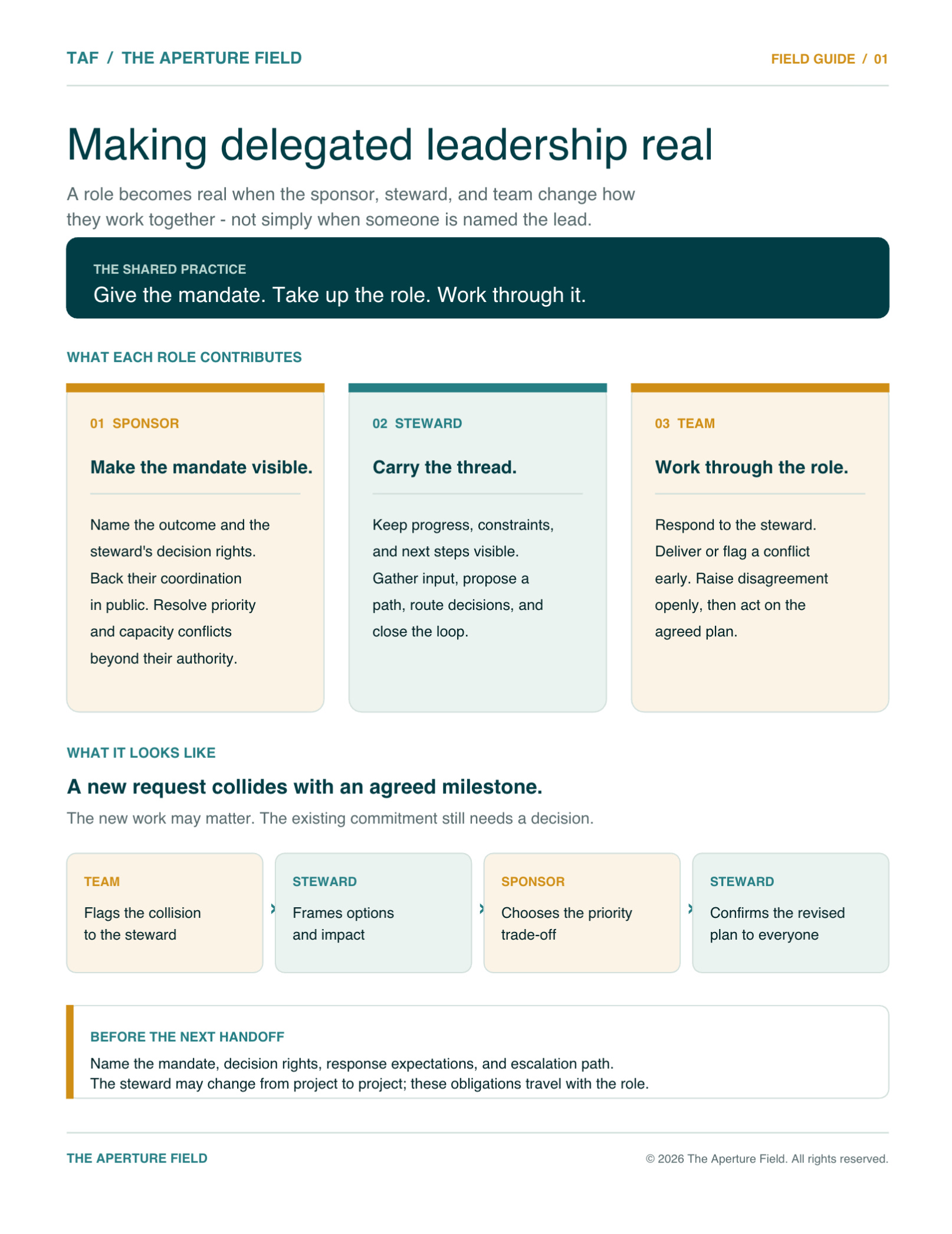
I used AI as a thinking and editing partner to help organize the article, refine and condense the writing, and create the accompanying Making Delegated Leadership Real one-page visual.
"Competence can prevent the system from developing competence." That one stung a little, in a good way. The founder who always catches the dropped ball is also the reason nobody else learns to catch it. I like that your drills include letting small misses stand long enough to become information. That's the step most people skip because it feels irresponsible in the moment.
The question of whether anyone knows where to be when the ball arrives is the real test of delegation. A practical habit is a three line handoff note covering what they own, what they can decide without asking, and what you want to hear back about. Ask the receiver to restate it in their own words, because the gaps show up in that restatement and not in the original.