

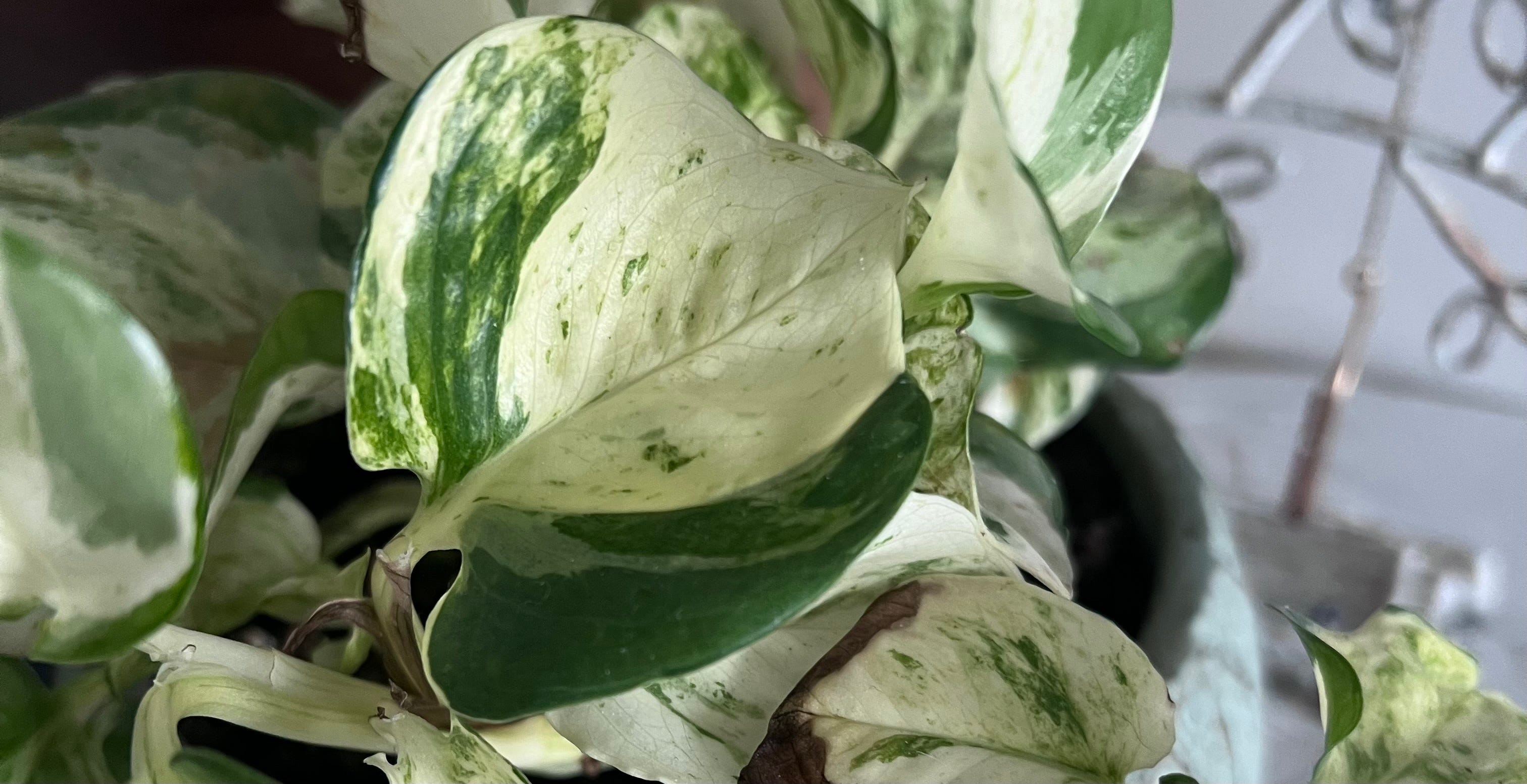
This morning I found myself contemplating a variegated Pothos I picked up from a plant shop that had recently closed.
It needed some care. Several of its leaves were marked (burned at the edges) from what I later learned were environmental control issues in the mall where the shop had been located. Too much light, not enough consistency - the kind of subtle imbalance that doesn’t kill immediately, but leaves its trace.
As I looked into how to help it recover, I came across something I hadn’t known before. In variegated plants (the ones with both white and green in their leaves) only the green portions perform photosynthesis. The white parts lack chlorophyll. They don’t produce energy in the same way because they are, in a sense, supported by the green. You could say the green is doing the work while the white is along for the ride.
And yet… that’s not quite right either.
Because sometimes, if too much of the leaf turns white, the plant begins to starve as there simply isn’t enough energy production to sustain it. Other times, when the green dominates, the plant becomes more robust and efficient but also more ordinary. In cultivation, those leaves are often cut away not because they don’t work, but because they don’t carry the aesthetic the plant is known for.
And when conditions become unstable, as they had in that failing shop, it is the white portions that suffer first. They crisp and then fail, revealing the fragility of the system.
It’s a strange balance:
Too much efficiency, and something is lost.
Too much beauty, and the system can’t sustain itself.
And somewhere in between, there is a form that holds both.
—
It reminded me of something Robert Pirsig explored deeply in Zen and the Art of Motorcycle Maintenance: this idea of “quality” that sits somewhere between the classical (structure, logic, science) and the romantic (aesthetic, experience, meaning).
We’ve spent generations pulling these apart. Science on one side; spirituality, art, and meaning on the other. Each refined, each made more precise, and each, in its own way, beautiful.
And in doing so, we’ve created the familiar camps:
“I’m on this side.”
“I’m on that side.”
But in the plant, there are no camps, there is only the leaf.
—
Standing in the shop, I passed by the fully green pothos without much thought. I know they grow faster and are more resilient. They would fill a shelf quickly, cascade easily, and do exactly what they are built to do.
And yet I chose the variegated one: Slower, more delicate, less efficient, and ultimately more interesting. But I also wouldn’t choose a plant that had gone almost entirely white because I know what would happen: It wouldn’t last as there wouldn’t be enough “engine” to sustain the form.
So what I’m drawn to, it seems, is not one or the other; it’s the integration. A living system that holds:
the part that works, and the part that reveals
the part that sustains, and the part that makes it worth sustaining
—
Maybe “quality” isn’t found in choosing between structure and aesthetics, but instead it lives in the proportion. In the quiet calibration between what carries the system and what gives it meaning.
Like a leaf that knows, somehow, how much green it needs… to support the white that makes it beautiful.