

I am part of a neighbourhood of arguably some of the nicest people around. This is a curious thing to say because I live in a place defined by density: twenty-storey apartment and condominium towers everywhere you turn, with communal spaces that seem just large enough to hold everyone, though you sometimes wonder how many more could fit.
When we think of a “neighbourhood,” many of us immediately picture something quite different: rows of suburban houses, small lawns, short hedges, and neighbours leaning over fences to exchange news about what is happening in the world. Yet my earliest experiences of neighbourhood looked very different from this image.
My mother grew up in a farming community of roughly 350 people, surrounded by wheat fields and located fifteen minutes from the nearest small city. When we visited my grandparents, no one used the front door. In fact, if someone knocked on it, the entire house would momentarily fall silent as everyone wondered who on earth it could be.
People simply walked up the driveway, slid open the glass door off the kitchen, and came in. By the time they reached the table, coffee was already being poured.
There was rarely ceremony. A casual “How’s it goin’?” was often enough. Unless, of course, the visitor had been away for a long time. Then hugs, laughter, and a warm sense of you belong here would ripple through the room.
What is striking to me is that these homes were often separated by a quarter mile or more. There was no cul-de-sac. No shared green space. No density. And yet, community was strong.
Later, I lived on Commercial Drive in Vancouver. The neighbourhood could not have been more different. It was dense, vibrant, and wonderfully eclectic: artists, families, professionals, breweries, activists, immigrants, and people living every imaginable version of life.
Community there was practiced differently. You called ahead. You arranged to meet for coffee. You scheduled playdates. You did not simply arrive unannounced. Home became sanctuary - a retreat from the constant sensory richness of “The Drive” itself. The street provided the shared experience while individual homes provided refuge.
Even there, however, I encountered another form of neighbourhood. A friend lived in a small condominium building where residents routinely left their doors open. Neighbours wandered in and out. Pets visited one another’s suites. When the building needed painting, residents collectively picked up brushes and completed the work together over a weekend. Somewhere between the paint, the shared meals, and perhaps a little beer, a genuine sense of family emerged.
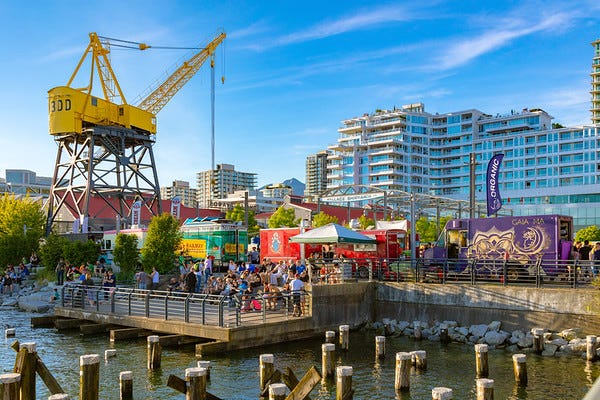
And now I live in Lower Lonsdale, where people strike up conversations in grocery store lines. They chat in elevators. They greet one another on the street. The city itself has intentionally created gathering places: outdoor skating rinks that become splash parks in summer, public plazas, markets, stages, and spaces that invite people outside and into one another’s lives.
Which makes me wonder: What actually makes a neighbourhood?
Is it a particular housing form? Is it single-family homes and front yards? Or is neighbourhood something deeper? Perhaps a way people choose to show up for one another within the constraints and opportunities of the places they inhabit? This question feels increasingly important.
Over the past twenty years, my community has changed dramatically. Like many places around the world, population growth and housing pressure have transformed what was once a relatively small community into a much denser one.
Imagine living somewhere for fifty years and watching, in what feels like an instant, thousands of new people arrive. Suddenly, the patterns of relationship that shaped your life no longer work in the same way.
People and families living in 800-square-foot apartments often experience the city differently than those living in detached homes. For someone raising a family in a small apartment, public spaces matter enormously. Parks, splash pads, skating rinks, transit, and green spaces become extensions of home itself. They are not luxuries; they are necessities.
For someone who has lived for decades in a detached home, community may centre around a backyard, a long-established network of neighbours, and a car that enables independence. Many have aged in place. Transit may not be physically practical or geographically convenient. Their needs are no less real.
Neither perspective is wrong - both emerge from lived experience.
What a challenge it must be to plan communities that must simultaneously house young families, maintain affordability, support economic vitality, and honour the needs of an aging population whose experience of place is rapidly changing.
Perhaps this is symbolic of many of the tensions we see today.
It is remarkably easy to cast those with different needs as the problem. Social media amplifies this tendency, magnifying feelings of being unseen, unheard, or left behind until frustration hardens into camps and camps harden into conflict. We speak louder and louder, hoping the other side will finally hear us.
But what if we reversed the sequence?
What if we entered these conversations with open ears first? What if we sought to truly understand another person’s lived experience before offering our own?
How might our communities change if understanding became our starting point rather than our destination?
Some of us have been around even longer in our timeline and due to moving, been part of many more communities with wide variance of community environments and neighborhood cultures. The most significant observation I can offer is this learning: that no matter the structure of a person's neighborhood, you CAN be involved with community improvement. Is the church your neighborhood? Is volunteering for litter cleanup your involvement? Is joining a protest your commitment to community? Do you alert members of your community to things affecting or potentially impacting your community? Even if your desire is to be left alone in your space and NOT be actively involved, do you treat those who invite you to involvement with respect that demonstrates your understanding of their need for more active involvement in community development? In every case, understanding first and then seeking to be understood is the proper order in living where you live. And surprise, surprise...in your work community as well.
Don't put off being involved in your community it is a living thing and your involvement helps direct what is important , and if you want to hermit yourself, seek first to understand. By belonging, you'll live better in either case. Don't put off being involved in your work community, either. Understanding the collective informs your part in continuous improvement in the life of your work. You will belong, and not just be a part of....