Prefer to hear this exploration instead? Listen below, or subscribe to The Aperture Field on your preferred podcast app.
We all recognize the hero: the leader who storms in when things are falling apart, the maverick who takes on what no one else will or the founder, executive, or ‘fixer’ who shoulders the impossible load and somehow makes it work. In Western culture, we revere this archetype.
They are decisive. Tireless. Action-oriented. When others hesitate, they move; when systems wobble, they stabilize them, often at great personal cost. Organizations reward this behavior again and again, promoting these individuals precisely because they “get things done” when no one else can and often save the day. But that success hides a deeper and more dangerous pattern.
We tell ourselves “many hands make light work,” but often the work was never light at all, and was carried by one or two people whose capacity masked a systemic failure. The hero didn’t just act, they absorbed what the system could not hold and because the crisis passed, the structure never had to change.
The shadow side of this archetype is not subtle and is at this point a stereotype: burnout, chronic pain and illness, strained marriages, and children who grow up resenting parents who were “always saving something, somewhere.”
Entrepreneurs and leaders are statistically more prone to anxiety, depression, and exhaustion than the general population not because leadership is inherently destructive, but because heroic over-functioning becomes an identity. Saving broken systems becomes how worth is measured, and once that identity is in place, stepping back feels impossible.
Because if you stop rescuing, who are you?
The uncomfortable truth:
The hero does not prevent fires.
They make it possible for the system to keep lighting them.
When someone repeatedly steps in at the point of crisis, the early warning signs are never dealt with and unclear roles remain unclear. The system learns unconsciously, but very effectively, that it does not need to adapt, because someone else will carry it.
Real leadership happens before the fire.
Leadership is not the dramatic moment when everything is about to collapse; it lives in the micro-decisions long before that moment in how work is structured, how responsibility is assigned, and what discomfort a leader is willing to allow.
Who is allowed to carry how much?
What friction is tolerated instead of absorbed?
Where does responsibility actually sit?
What happens when someone does not step in?
Leaders are not there to carry the system.
They are there to design the system so no one has to.
Healthy systems distribute load early, not heroically late. They allow discomfort before catastrophe by letting small failures teach and requiring each person to hold a share of the weight, no more/no less, and to remain accountable for it. When this happens, there is no need for saviors because there is no blaze that requires one person to run into the flames.
The “villain” in the villainous hero archetype isn’t the individual, it’s the timing. When leaders repeatedly intervene too late (at the point of collapse), they unintentionally undermine the very resilience they believe they are protecting. What looks like strength is actually structural dependency, and because the hero often is capable, the damage remains hidden until the body, the family, or the system finally refuses to continue.
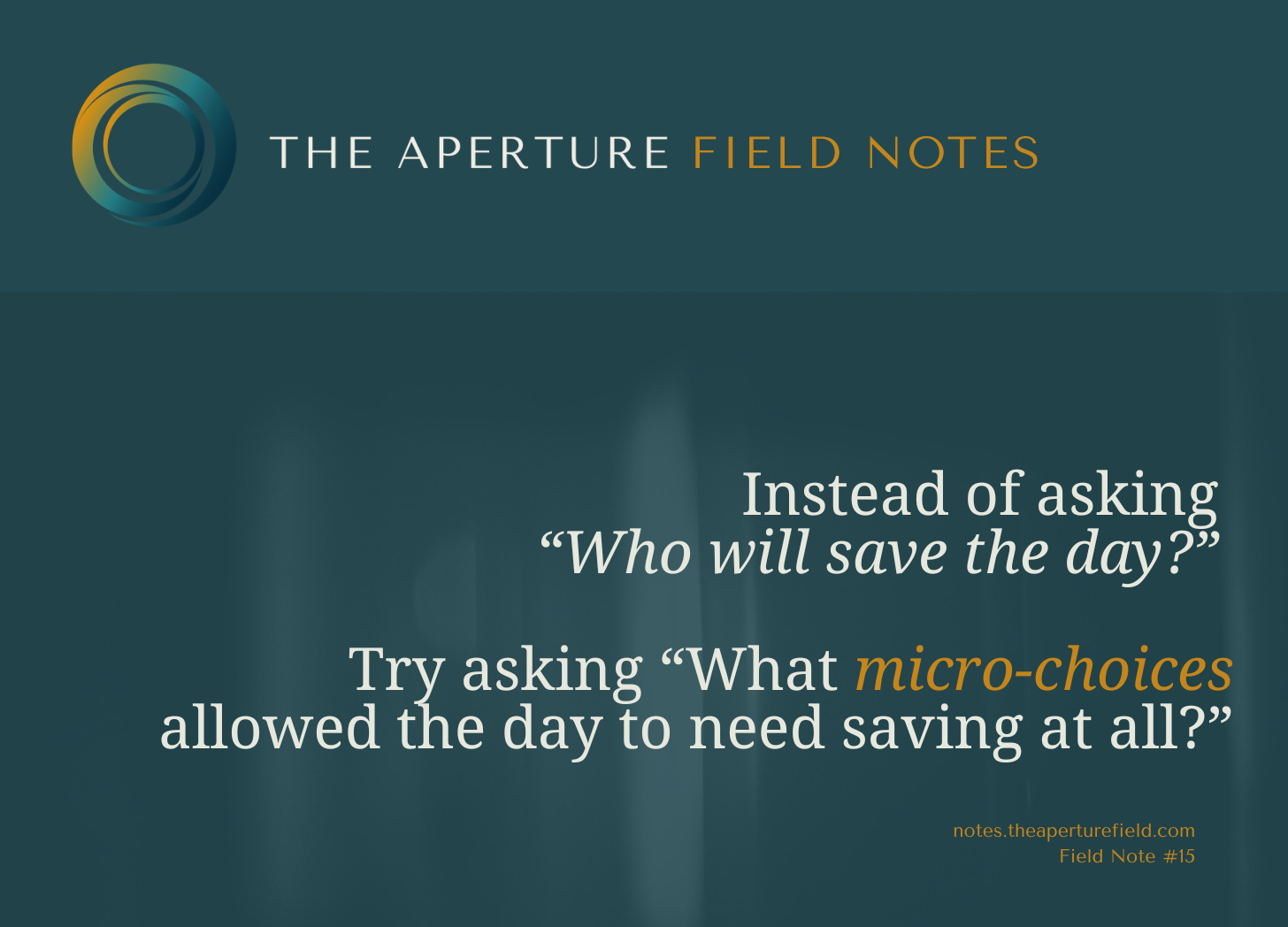
Instead of asking “Who will save the day?”
Try asking “What micro-choices allowed the day to need saving at all?”
And, more personally:
Where do I step in before I’m asked?
Where do I absorb friction to keep things running smoothly?
Where does my competence prevent others from developing theirs?
These questions are uncomfortable, but they are the questions that dismantle the hero trap.
Leadership isn’t about carrying more. It’s about carrying correctly.
Like a rowing shell lifted by many hands: when each person takes only their portion of the weight, the load feels almost light. When one person compensates for the whole, it becomes crushing. The goal is not to drop the shell. It’s to stop lifting weight that was never yours to bear.
If you recognize yourself in this archetype, this isn’t a call to abandon responsibility, it’s a call to change where in the timeline you intervene. Not at the blaze, but at the first spark.
Intervening at the point of crisis looks like strength,
but intervening at the point of design is leadership.