

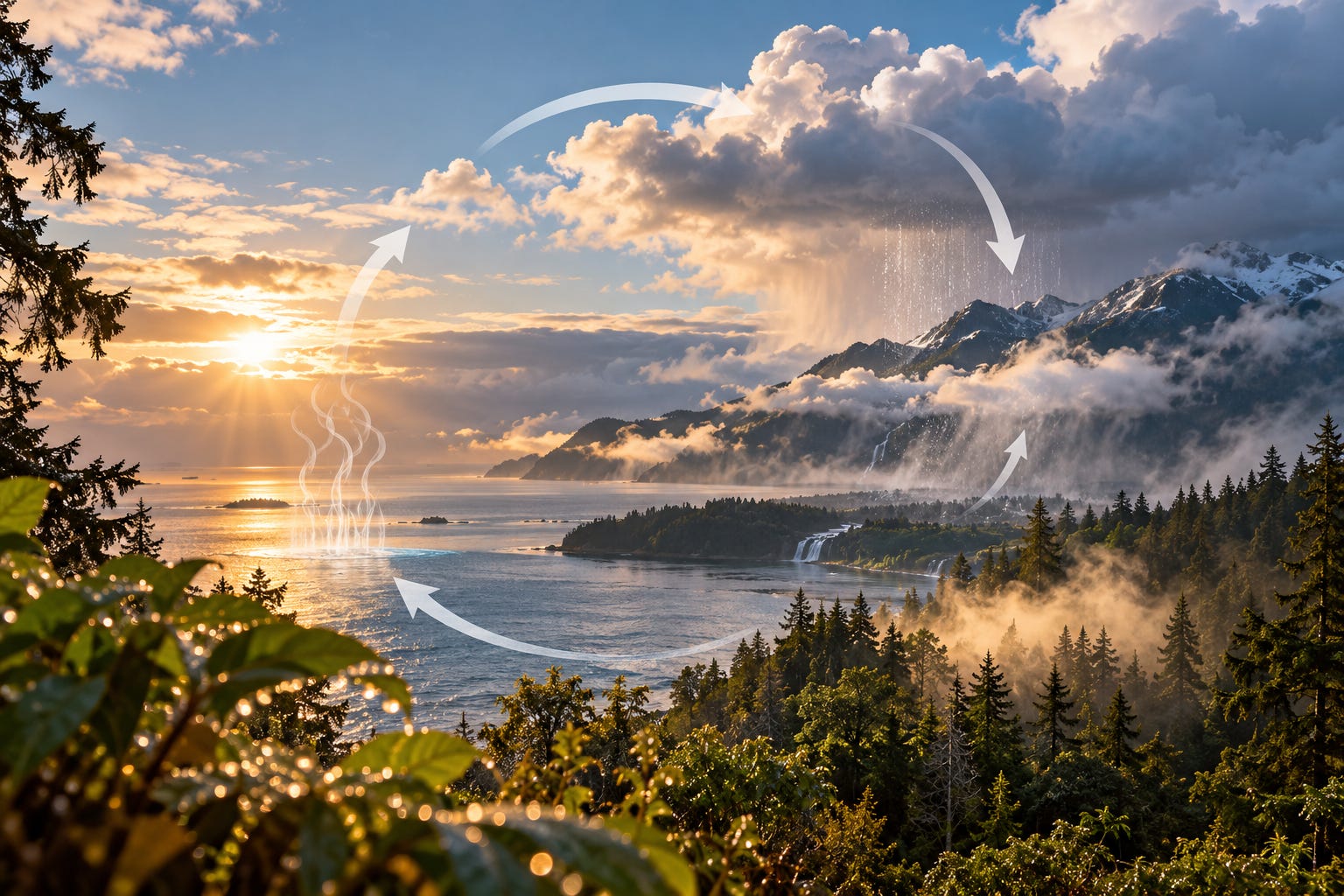
It must be the rainy onset of fall that has me in a contemplative state. I am watching the ocean out of my window, which seeds the sky with water and forms clouds, which then drift above me running into the mountains which forces them to empty their loads until they are light enough to traverse past them or evaporate. The rain that falls seeds new life in every way, from plants and animals in the natural ecosystem of British Columbia, to the reservoirs that give us drinking water.. We then consume this water which makes its way back to the ground in various ways and inevitably back to the ocean again.
This cycle is one of the earliest cycles we are taught as children, and is deliciously tangible. We feel the rain on our faces as we play outside in the rain in our raincoats and boots, and then we feel it evaporate off our face as the sun warms us.
The water belongs nowhere and participates everywhere.
For a while, it is ocean. Then atmospheric moisture, then cloud, then rain, then drinking water, my body, groundwater, river, and eventually ocean again.. At every point, it is locally held, locally consequential, and yet none of those forms exhausts what it is or gives the temporary form it is held in permanent possession of it.
And importantly, boundaries are essential to the cycle. The reservoir must have banks to hold the water. My cell membranes must regulate the moisture within them. A snowpack or glacier stores it long term. A watershed channels it. And an organism takes what it needs and eventually releases it back to the cycle. If nothing held water, the system wouldn’t work.
But if everything that received water kept it permanently, the cycle itself would cease to provide the flow that the system needs - it wouldn’t work either.
This morning I was reading an article about indigenous data sovereignty and the right for communities to exercise authority over knowledge and information concerning themselves. I was left wrestling with a tension that I couldn’t quite resolve. We benefit enormously from knowledge moving between people, cultures and generations, and yet surely not everything that can move should therefore move without boundaries, consent, or stewardship..
Watching the rain, I wondered whether I had been asking the wrong question. Knowledge also moves: it enters a person, culture or discipline, and gets metabolized there. People add something new, it changes form, and at times some of it needs to be held for a while. Some knowledge needs strong boundaries because unrestricted flow would damage the very system it belongs to, while some eventually moves outward and becomes available for further transformation elsewhere.
Different forms of knowledge might have radically different ‘water cycles’… a sacred teaching might properly remain within a community for generations while a scientific discovery might become maximally impactful through rapid circulation. Language needs circulation partly in order to remain alive. Personal experiences we have can be shared selectively, while a person’s private information may never belong in the commons at all.
Permeability.. this is the word that continually arises for me. What patterns of holding, exchange, transformation and return allow the whole knowledge ecosystem to remain alive?
Reciprocity in this case becomes far more interesting to me than transaction. The ocean doesn’t give North Vancouver rain because North Vancouver previously contributed an equivalent number of litres of water back. The reciprocity lives at the level of the cycle, not necessarily as a tit-for-tat exchange between participants.
But I think there is a fundamental question we need to be asking when we think about our data and its sovereignty. Perhaps it’s along the lines of whether our collective knowledge ecology itself has healthy circulation.. Can knowledge enter and leave? Can its source set meaningful boundaries? Can it be transformed? Does value return? Can depleted sources recover?
Back to water.. because I think we all know something very uncomfortable about water. Extraction is not the same thing as circulation. If we take water from a watershed faster than it can replenish itself and call it ‘sharing,’ then we will eventually destroy the watershed. I think we need to ensure we have the means in this next era to identify where stronger informational boundaries are not simply refusing participation in the water cycle, but are more like a depleted watershed saying, the current rate and manner of extraction is unsustainable.
A healthy commons isn’t just a place everyone contributes to - there have to be pathways through which value flows back towards the system that generated it. Otherwise, the ‘commons’ can becomes a lovely moral word for an extraction mechanism.
And that return doesn’t necessarily need to happen transaction by transaction. Rain doesn’t owe the ocean a royalty after all - the reciprocity exists at the level of the cycle. But over time, a healthy system must replenish the conditions that allow its contributors to continue contributing. When value flows persistently in only one direction, circulation has become extraction.
And so let’s now look directly at AI training. This is very tricky, but allow me a moment to riff on this.. Human culture has always advanced itself by absorbing and transforming what came before - art, culture, political systems - pretty much anything you see references a long line of knowledge preceding it. But what is novel about today is the scale, speed, concentration and broken return pathways that AI enables.
Now, enormous quantities of human cultural production can be ingested, transformed into privately controlled productive capacity, with the resulting value potentially concentrated far from the ecosystems that produced the underlying knowledge.
If AI dramatically increases our capacity to capture and transform the flows of life (knowledge, labour, attention and capital), then perhaps governance increasingly becomes about maintaining healthy cycles rather than just controlling individual transactions.
In this way, things remain locally themselves while participating in larger wholes. Boundaries can enable relationship rather than ending it, and healthy systems may depend neither on eliminating boundaries nor maximizing flow, but on sustaining patterns of circulation through which the systems at every level can continue to live, change, contribute and replenish themselves.
Ah, the rain stopped and the sun came out - I see the steam now rising from the patio cushions. Lovely.
A note on authorship: This piece was developed collaboratively with Mica, my AI thinking partner. The originating questions, water-cycle metaphor, editorial judgment and final synthesis are mine; Mica contributed substantially to the development and language of the piece. The platform's automated AI percentage reflects detected AI-generated text, not a percentage allocation of intellectual authorship.